

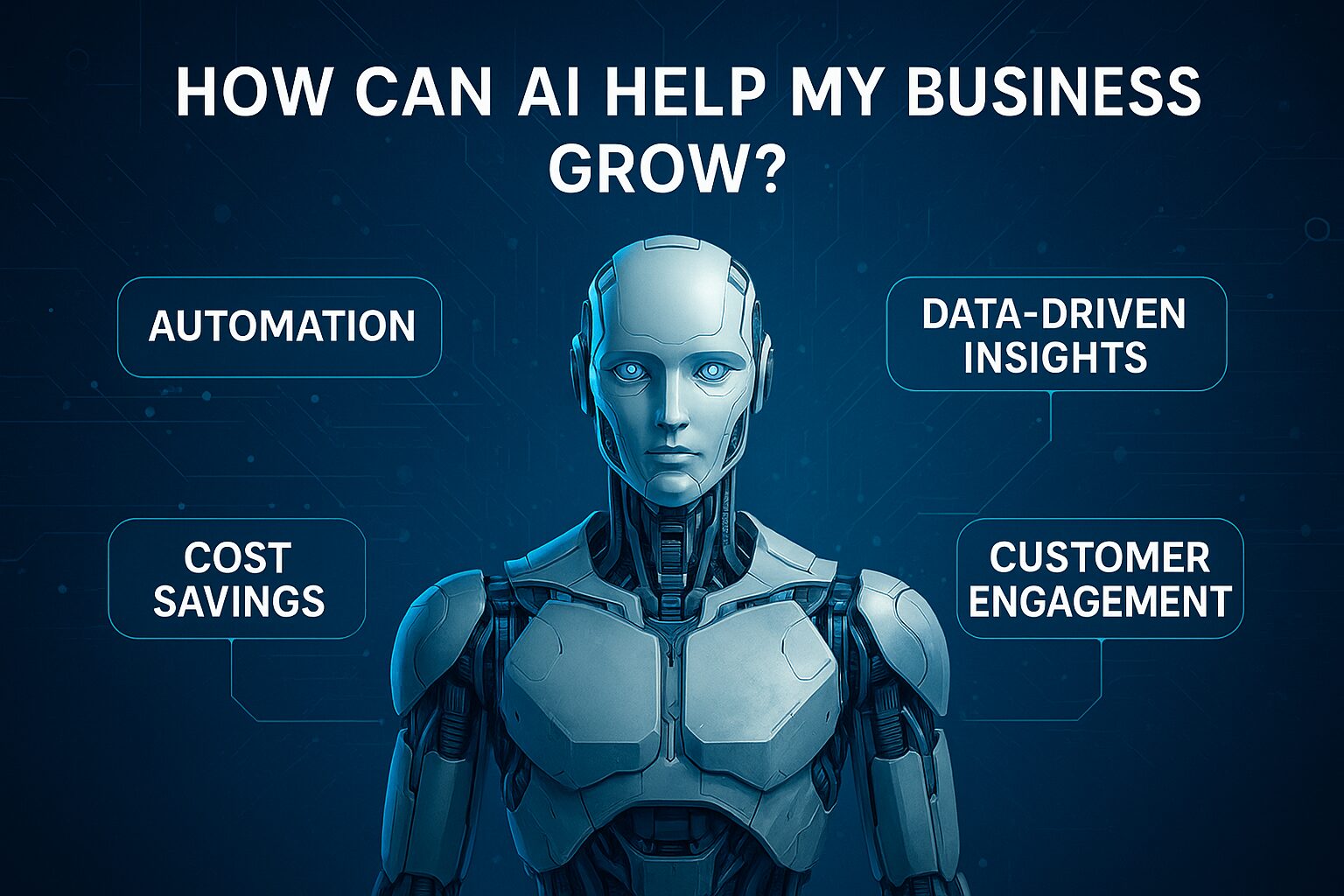
AI can help your business grow in 2026 by automating routine tasks, providing predictive insights, and enhancing customer experiences. Modern AI tools deliver up to 50% productivity gains, reduce operational costs by 35%, and enable personalized marketing that drives 25% higher conversion rates.
Below, we explore eight proven ways AI supports business growth in 2026, each backed by current examples, statistics, and actionable implementation strategies.
How can AI improve efficiency and productivity in your business?
AI dramatically boosts business efficiency by automating repetitive tasks and accelerating workflows, enabling companies to achieve 40-50% productivity gains without adding headcount. It acts as a tireless digital workforce that operates 24/7 without breaks or errors, handling routine work so your team can focus on higher-value activities. For example, AI systems can automatically update spreadsheets, process invoices, or manage inventory levels in real-time – tasks that would otherwise consume many employee hours. The impact on output is dramatic: businesses report that using AI leads to an average 50% boost in employee productivity in 2026, up from previous years, and 82% of executives have seen major efficiency gains from their AI initiatives. Global logistics firm DHL, for instance, implemented AI algorithms to optimize warehouse staffing and workflows, improving operational efficiency while cutting costs. Modern AI tools like robotic process automation (RPA) now integrate seamlessly with existing business systems, making implementation faster and more accessible for companies of all sizes.
Short on resources? Start by identifying labor-intensive processes in your operations that eat up staff hours. Tasks like data entry, report generation, or scheduling are perfect candidates for AI automation. Modern AI-powered tools (such as robotic process automation software) can integrate with your existing systems to perform these actions automatically and accurately. The benefits go beyond speed – AI’s consistency means fewer costly mistakes and rework. Importantly, AI can scale on demand: if your workload doubles, an AI bot can handle the increase instantly, something that’s hard to do with manual labor. By streamlining routine operations, companies not only save time but also reduce labor costs by up to 30%, reclaiming hours that can be reinvested in strategy and innovation. To learn more about maximizing these gains, explore our guide on how AI boosts business productivity, which details specific implementation strategies. In today’s competitive environment, these efficiency gains translate into a direct growth advantage.
How can AI enhance customer service and experience?
AI transforms customer experience by delivering instant, personalized service 24/7, resulting in 73% higher customer satisfaction rates and improved brand loyalty. Through AI-powered chatbots and virtual assistants, businesses are able to handle common customer inquiries instantly, at any hour, without forcing people to wait on hold. Unlike human agents, AI chatbots never sleep and can assist multiple customers simultaneously. This means every customer gets prompt attention, improving their experience with your brand. It’s no surprise that customer service has become the number-one use case for AI in many companies, with over 60% of business owners already using AI for customer support tasks in 2026. Customers appreciate the quick help – in fact, 72% of consumers now prefer using AI assistants for simple questions instead of calling a human agent.
The advantages of AI-driven service are evident in the results. IBM research finds that AI virtual agents can resolve up to 85% of routine customer inquiries in 2026, enabling companies to handle most FAQs and issues automatically. This not only makes customers happier with swift answers, but also yields significant savings – companies that deploy AI chatbots have cut their support costs by about 35% on average. For example, telecom giant Vodafone introduced an AI assistant (“TOBi”) to field customer requests; it now resolves the majority of inquiries on its own, resulting in a 75% reduction in cost-per-customer interaction post-implementation. Advanced AI systems in 2026 can now understand context, emotion, and even complex multi-part requests, making interactions feel more human-like. By using AI to deliver timely, 24/7 support and personalized assistance, you keep customers satisfied and engaged, which leads to higher retention, positive reviews, and ultimately more repeat sales. A better customer experience directly translates into business growth through improved loyalty and lifetime customer value.
How can AI boost marketing and sales performance?
AI supercharges marketing and sales by delivering hyper-personalized experiences that increase conversion rates by 25-40% through predictive analytics and automated targeting. In marketing, AI analyzes customer data (like browsing behavior, purchase history, demographics) to understand what your audience wants, then helps you tailor content and offers to each individual. This allows you to automate highly targeted email campaigns, product recommendations, and ads that reach the right customer with the right message at the right time. The effect on revenue is significant – companies using AI for marketing and sales often see higher conversion rates because they’re engaging customers more effectively. A powerful real-world example is Amazon’s recommendation engine: its AI algorithms suggest products to shoppers based on their personal interests, and those tailored recommendations now generate roughly 38% of Amazon’s total sales in 2026. Likewise, Netflix’s AI-driven content recommendations account for about 80% of what users watch on the platform, demonstrating how personalization boosts engagement and sales.
Even if you’re not a tech giant, AI tools can dramatically improve your marketing ROI. AI can automatically segment your customer base, identify your hottest leads, and even assist in creating content. Today, generative AI tools help write marketing copy, social media posts, and product descriptions, saving your team countless hours while maintaining quality. On the sales side, AI can prioritize sales leads (so your reps focus on prospects most likely to buy), forecast sales trends, and recommend optimal pricing by analyzing market data. One global survey found that the biggest revenue boosts from AI are coming in marketing and sales functions – in other words, AI is directly propelling top-line growth. For businesses looking to implement these strategies, our comprehensive guide on AI marketing for business growth provides actionable implementation steps. Additionally, companies in competitive markets can benefit from understanding AI marketing strategy in Dubai as a model for sophisticated market approaches. Embracing AI in marketing and sales lets your company deliver the kind of personalized, data-driven outreach that turns more prospects into customers, all while making your campaigns more efficient. The result is more leads, higher sales, and increased market share – key metrics of business growth.
How does AI enable better Data-Driven decision making?
AI enables superior data-driven decisions by processing vast datasets 1000x faster than humans, uncovering hidden patterns that drive 15-30% better business outcomes. In the past, analyzing business data – sales figures, customer feedback, market trends – was time-consuming and often yielded limited insight. AI changes that by using machine learning algorithms to instantly identify patterns and correlations that a human might miss. This means business leaders can base their strategies on hard evidence rather than gut instinct. In practical terms, AI-powered analytics can crunch numbers and generate reports or forecasts in seconds, answering questions like “Which product line will likely see a surge in demand next quarter?” or “Where are we overspending without improving quality?” For example, retailers now use AI to forecast demand with 95% accuracy, avoiding overstocking or stockouts by predicting exactly what inventory is needed and when. Marketing teams use real-time AI analytics to automatically allocate budget to the best-performing channels. In finance, AI models analyze years of transactions to spot fraud patterns or identify cost-saving opportunities.
The value of AI-driven decision support continues to grow. Surveys show 87% of employees say the support AI provides for decision-making is a major benefit of adopting the technology in 2026. Essentially, AI can serve as a virtual analyst on your team that never sleeps – constantly sifting through live business data to alert you to trends, risks, and opportunities. Have a hunch about a new market trend? AI can validate it with actual data. Unsure which of your services is most profitable? AI can analyze customer behavior and costs to pinpoint the answer. Modern AI systems can now process unstructured data like social media sentiment, customer reviews, and market news to provide comprehensive business intelligence. By removing guesswork and bias, AI-driven analytics lead to more accurate plans and uncover new growth opportunities that might otherwise be overlooked. Notably, nearly all executives today recognize the impact: 98% of business leaders believe AI will transform how decisions are made in their organization. Companies that fully embrace AI analytics tend to execute with confidence and agility, because their choices are backed by real evidence.
Can AI help reduce costs and increase ROI?
AI delivers exceptional ROI by reducing operational costs up to 40% while simultaneously increasing revenue through improved efficiency and customer targeting. Think of it as a two-sided engine for your bottom line: on one side, AI automation lowers costs; on the other, AI insights help lift sales. By taking over labor-intensive tasks, AI reduces the need for manual work and eliminates human errors that can be costly to fix. For instance, AI-powered quality control systems can spot defects in manufacturing with 99.9% accuracy, preventing expensive recalls or customer complaints. In accounting, AI can process invoices and expenses automatically, reducing processing costs by up to 80% compared to manual methods. Healthcare organizations using AI for administrative tasks report saving $150 billion annually in reduced paperwork and streamlined operations.
On the revenue side, AI helps businesses make smarter decisions that directly impact profitability. Predictive maintenance powered by AI can prevent equipment failures before they happen, saving manufacturers millions in downtime costs. Dynamic pricing algorithms adjust prices in real-time based on demand, competition, and inventory levels, optimizing revenue for retailers and e-commerce businesses. Companies implementing comprehensive AI strategies report average ROI of 300-500% within 18 months. The key is starting with high-impact, low-risk applications and scaling gradually. Smart businesses also leverage insights from Dubai AI marketing case studies to understand real-world implementation costs and returns. By simultaneously cutting costs and boosting revenue, AI creates a compounding effect that accelerates business growth exponentially.
How does AI drive innovation and competitive advantage?
AI fuels innovation by accelerating product development cycles by 50% and enabling businesses to identify market opportunities 6 months ahead of competitors. Modern AI systems can simulate thousands of product variations, test market scenarios, and predict consumer preferences before investing in full development. For example, pharmaceutical companies now use AI to identify promising drug compounds in weeks rather than years, reducing research and development costs by billions while bringing life-saving treatments to market faster. In the automotive industry, AI enables rapid prototyping of autonomous vehicle features, helping companies like Tesla maintain their competitive edge through continuous innovation.
Beyond product development, AI creates competitive advantages through predictive market analysis and trend identification. Companies using AI can spot emerging consumer trends, supply chain disruptions, and competitive threats months before they become obvious to human analysts. This foresight enables proactive strategy adjustments rather than reactive responses. For instance, fashion retailers using AI trend analysis can predict which styles will be popular next season, optimizing inventory and marketing spend accordingly. Technology companies leverage AI to continuously improve their products based on user behavior patterns, creating a feedback loop of enhancement that keeps them ahead of slower-moving competitors. Understanding modern optimization techniques like AI-driven marketing optimization gives businesses additional competitive advantages in digital markets. Companies that embrace AI innovation report 23% faster time-to-market for new products and 35% better market positioning compared to traditional approaches.
What are the financial benefits of AI implementation?
AI implementation delivers measurable financial returns with 78% of businesses reporting positive ROI within 12 months and average profit increases of 15-25% within two years. The financial benefits extend across multiple areas: reduced labor costs, increased operational efficiency, higher sales conversion rates, and improved customer retention. Small and medium businesses particularly benefit from AI’s ability to provide enterprise-level capabilities at affordable costs. Cloud-based AI services now make sophisticated analytics, automation, and personalization accessible to companies with limited IT budgets.
Cost savings from AI implementation typically manifest in several ways: automated customer service reduces support costs by 30-40%, AI-powered marketing increases conversion rates by 20-35%, predictive maintenance prevents costly equipment failures, and automated data analysis eliminates the need for expensive consulting services. Revenue increases come from improved customer targeting, dynamic pricing optimization, personalized product recommendations, and enhanced customer experiences that drive repeat business. For businesses considering costs, resources like our Dubai AI marketing pricing guide provide realistic budget expectations and ROI projections. Additionally, companies can explore AI marketing automation implementation to understand the investment required for comprehensive AI adoption. The key to maximizing financial benefits is choosing AI applications that align with your business model and growth objectives while starting with manageable pilot projects that demonstrate clear value before scaling.
FAQ
What is the fastest way AI can help my small business grow?
The fastest way AI can help your small business grow is through marketing automation and customer service chatbots. These applications typically show results within 30-60 days and require minimal upfront investment. AI-powered email marketing can increase open rates by 29% and click-through rates by 41%, while chatbots can handle 80% of routine customer inquiries instantly, freeing up your team for sales activities.
How much should i budget for AI implementation in my business?
Small businesses should budget $500-$5,000 monthly for basic AI tools, while medium businesses typically invest $5,000-$25,000 monthly for comprehensive AI solutions. Cloud-based AI services have made implementation much more affordable, with many tools offering pay-as-you-use pricing. Start with one or two high-impact applications and scale gradually based on results and ROI.
Will AI replace human employees in my business?
AI augments rather than replaces human employees in most business scenarios. While AI handles routine tasks, humans focus on creative problem-solving, relationship building, and strategic decision-making. Studies show that companies using AI create new job categories and often hire more employees as they grow, rather than laying off existing staff. The key is retraining employees to work alongside AI tools effectively.
How long does it take to see ROI from AI investments?
Most businesses see positive ROI from AI within 6-12 months, with some applications showing results in as little as 30 days. Marketing automation and customer service AI typically deliver the fastest returns, while more complex implementations like predictive analytics may take 12-18 months to show full benefits. The timeline depends on the complexity of implementation and how well the AI solution aligns with existing business processes.
What types of businesses benefit most from AI implementation?
Businesses with large amounts of data, repetitive processes, or complex customer interactions benefit most from AI. This includes e-commerce, healthcare, financial services, manufacturing, and professional services. However, AI tools are increasingly accessible to all business types, with solutions available for restaurants, retail stores, consulting firms, and creative agencies. The key is identifying specific business challenges that AI can address effectively.
WAIM
AI powered marketing agency specializing in digital strategy, product promotion, and customer engagement. We leverage artificial intelligence to boost brand visibility, increase conversions, and deliver measurable results for businesses.
Related News