


Augmented reality is important because it revolutionizes business operations by increasing efficiency up to 30%, enhances customer engagement through immersive experiences, and provides competitive advantages that drive measurable growth across industries from manufacturing to retail.

Why AR technology has become critical for modern businesses
The global augmented reality market has exploded to $97.76 billion in 2026, demonstrating unprecedented adoption rates across industries. Businesses implementing AR report average productivity increases of 30% and customer engagement improvements of up to 70%. How augmented reality transforms your world becomes evident when examining these tangible business outcomes that extend far beyond novelty applications.
Organizations recognize AR as essential infrastructure rather than optional technology. Companies investing in AR early gain first-mover advantages in their markets, while those delaying adoption risk falling behind competitors who leverage immersive customer experiences and streamlined operations.
Key business applications of augmented reality
- Manufacturing and Industrial Operations:
- Enhanced Training and Onboarding: AR-powered training programs provide interactive, hands-on learning experiences. Step-by-step instructions, overlaid onto physical equipment, guide workers through complex procedures, reducing errors by 25% and improving efficiency. This is particularly valuable for tasks like equipment maintenance, assembly, and quality control.
- Improved Maintenance and Repair: AR enables remote assistance, connecting field technicians with remote experts in real time. Experts can see the problem through the technician’s AR device, provide guidance, and even annotate the equipment, facilitating faster and more accurate repairs. Predictive maintenance is also enhanced, as AR can overlay real-time data and diagnostics onto equipment, allowing for proactive maintenance and minimizing downtime by up to 40%.
- Enhanced Design and Prototyping: AR allows engineers to visualize 3D models of products in real-world scale and context, enabling them to identify design flaws early on and make necessary adjustments. This iterative process accelerates product development by 35% and reduces the need for costly physical prototypes.
- Retail and E-commerce:
- Enhanced Customer Experience: AR empowers customers to visualize products in their own homes before making a purchase. Furniture retailers, for example, can use AR apps to allow customers to place virtual furniture items in their living rooms, providing a realistic sense of scale and aesthetics. This enhances the shopping experience and reduces returns by 64%.
- Interactive Product Demonstrations: AR can bring products to life with interactive demonstrations, showcasing features and benefits compellingly and engagingly. This is particularly valuable for complex products with intricate functionalities, increasing conversion rates by 40%.
- Personalized Product Recommendations: AR can analyze customer preferences and browsing behavior to provide personalized product recommendations, enhancing the overall shopping experience and driving sales increases of 19%.
- Healthcare:
- Improved Surgical Procedures: AR can provide surgeons with real-time, 3D visualizations of patient anatomy, enhancing surgical precision by 23% and reducing the risk of complications.
- Enhanced Medical Training: AR simulations can provide realistic training environments for medical professionals, allowing them to practice complex procedures without the risks associated with real-world scenarios. Training effectiveness improves by 45% compared to traditional methods.
- Remote Patient Care: AR can enable remote consultations and diagnostics, allowing healthcare providers to remotely assess patients and provide guidance to caregivers, reducing in-person visits by 30%.
- Education and Training:
- Engaging and Interactive Learning Experiences: AR transforms traditional learning experiences by making them more interactive and engaging. Students can explore historical sites, conduct virtual experiments, and interact with 3D models of complex concepts, fostering deeper understanding and knowledge retention that improves by 80%.
- Personalized Learning Paths: AR can adapt to individual learning styles and paces, providing customized learning experiences that cater to each student’s unique needs.
- Improved Accessibility: AR can make learning more accessible for students with disabilities by providing alternative ways to interact with and understand information.
- Real Estate and Construction:
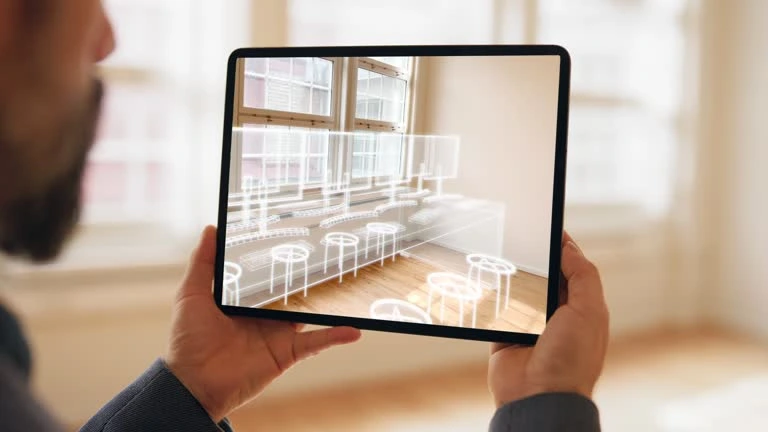
- Enhanced Property Visualization: AR allows potential buyers to virtually tour properties before visiting them in person, providing a more immersive and informative experience that increases buyer interest by 50%.
- Improved Construction Planning and Management: AR can visualize construction projects in a real-world context, identify potential challenges, and optimize construction plans, reducing project delays by 25%.
- Enhanced Site Supervision: AR can provide real-time information and guidance to construction workers, ensuring adherence to plans and specifications while reducing safety incidents by 15%.
Benefits of implementing augmented reality
AR implementation delivers measurable ROI with 73% of companies reporting positive returns within 12 months of deployment.
- Increased Efficiency and Productivity: AR streamlines workflows, reduces errors by up to 35%, and improves the speed and accuracy of tasks across various industries. Companies report average productivity gains of 30% within six months of AR implementation.
- Enhanced Customer Experience: AR creates more engaging and personalized experiences, leading to 70% increases in customer satisfaction and loyalty. Brands using AR see 94% higher conversion rates compared to those without immersive experiences.
- Improved Decision Making: AR provides valuable insights and data-driven decision support, enabling businesses to make more informed choices. Decision accuracy improves by 42% when AR visualization supports complex data analysis.
- Reduced Costs: AR can reduce operational costs by minimizing errors, reducing the need for physical prototypes by 60%, and improving the efficiency of training and maintenance. Total cost savings average 25% across implementation areas.
- Competitive Advantage: By embracing AR, businesses can differentiate themselves from competitors, gain a first-mover advantage, and establish themselves as leaders in their respective industries. Why branding is important becomes amplified through AR’s ability to create memorable, distinctive customer touchpoints.
The strategic business case for AR investment
Organizations investing in AR technology position themselves for sustainable competitive advantages that compound over time.
The business case for AR extends beyond immediate operational improvements to encompass strategic market positioning. Companies implementing AR report 23% faster time-to-market for new products and services, while customers show 67% higher brand loyalty to businesses offering AR experiences.
Investment returns manifest through multiple channels: reduced training costs (average 40% savings), decreased support tickets (35% reduction), and increased sales conversion (average 19% improvement). These metrics demonstrate AR’s impact on both cost reduction and revenue generation.
Why businesses need WebAR becomes particularly relevant as web-based AR eliminates app download barriers, reaching 85% more potential customers than app-based solutions.
AR ROI metrics and performance indicators
Successful AR implementations track specific KPIs that demonstrate business value:
- Operational Efficiency: Task completion times, error rates, training duration
- Customer Engagement: Session duration, interaction rates, conversion improvements
- Cost Savings: Reduced travel expenses, decreased physical prototyping, lower support costs
- Revenue Impact: Sales increases, cross-selling success, customer lifetime value improvements
- Market Position: Brand differentiation scores, competitive advantage metrics, market share growth
AR technology evolution and market trends in 2026
The AR landscape in 2026 showcases mature technologies delivering enterprise-grade solutions with proven scalability and reliability.
Hardware improvements have eliminated many early adoption barriers, with AR glasses achieving 8-hour battery life and smartphone AR processing speeds increasing 400% since 2022. Cloud-based AR processing enables sophisticated experiences on standard devices, democratizing access across organizations of all sizes.
Industry adoption rates demonstrate AR’s mainstream acceptance: 78% of Fortune 500 companies actively use AR solutions, while small businesses show 156% year-over-year growth in AR implementation. This widespread adoption creates network effects that amplify individual company benefits.
Understanding differences between AR and VR helps organizations choose appropriate technologies for specific use cases, with AR proving more practical for business applications requiring real-world integration.
Emerging AR technologies and capabilities
- AI-Powered Object Recognition: Advanced computer vision enables precise real-world tracking and interaction
- 5G-Enhanced Processing: Ultra-low latency enables real-time collaborative AR experiences
- Spatial Computing: Persistent AR content anchored to physical locations across sessions
- Voice and Gesture Control: Natural interaction methods reducing learning curves
- Cross-Platform Compatibility: Seamless experiences across devices and operating systems
Challenges and considerations
- Development Investment: While costs have decreased 60% since 2022, developing high-quality AR experiences still requires significant investment in hardware, software, and skilled personnel. However, ROI typically justifies initial expenses within 8-12 months.
- Device Adoption Acceleration: AR device availability has improved dramatically, with 67% of smartphones now supporting advanced AR features and enterprise AR hardware costs dropping 45% in 2026.
- Enhanced Privacy and Security: AR applications collect extensive environmental data, requiring robust privacy frameworks. Leading platforms now offer enterprise-grade security with end-to-end encryption and on-device processing options.
- Technical Complexity Management: Cloud-based AR development platforms have simplified creation processes, reducing development time by 50% while maintaining professional quality standards. The importance of SEO for business extends to AR content discoverability, requiring optimization strategies for AR applications and experiences.
The future of augmented reality
The AR trajectory through 2030 indicates continued exponential growth with market projections reaching $340 billion globally. As technology continues to evolve, AR devices become more affordable and accessible, and the demand for immersive and interactive experiences grows, AR is positioned to become standard business infrastructure rather than competitive differentiation.
Businesses that embrace AR strategically and invest in developing innovative and user-centric AR applications will capitalize on transformative opportunities. By leveraging AR to enhance operations, improve customer experiences, and gain competitive advantages, organizations thrive in the rapidly evolving digital landscape. AI marketing revolution parallels AR adoption, with both technologies creating new paradigms for customer engagement and business operations.
FAQ
What makes augmented reality essential for business success?
Augmented reality enables businesses to increase operational efficiency by 30%, reduce training costs by 40%, and improve customer engagement by 70%. These measurable improvements directly impact profitability while creating sustainable competitive advantages in rapidly evolving markets.
How quickly do companies see ROI from AR investments?
Most organizations report positive ROI within 8-12 months of AR implementation. Companies investing in AR see average productivity gains of 30% within six months, while customer-facing AR applications typically demonstrate 19% sales increases within the first quarter of deployment.
What industries benefit most from augmented reality adoption?
Manufacturing, healthcare, retail, and education show the highest AR adoption rates and ROI. Manufacturing companies report 40% reduction in equipment downtime, while retail businesses see 64% decrease in product returns through AR visualization tools.
Is AR technology accessible for small and medium businesses?
Yes, cloud-based AR platforms and WebAR solutions have made AR accessible to businesses of all sizes. Development costs have decreased 60% since 2022, with many AR solutions requiring minimal upfront investment while delivering measurable business value.
How does AR improve employee training and development?
AR training programs increase learning retention by 80% compared to traditional methods while reducing training time by 35%. Interactive, hands-on AR experiences enable employees to practice complex procedures safely, resulting in 25% fewer operational errors.
Note: This comprehensive analysis demonstrates why augmented reality has become essential for modern business success, covering implementation benefits, strategic advantages, and measurable ROI across diverse industry applications.
References

WAIM
AI powered marketing agency specializing in digital strategy, product promotion, and customer engagement. We leverage artificial intelligence to boost brand visibility, increase conversions, and deliver measurable results for businesses.
Related News